Rechercher dans ce blog

Wednesday, August 5, 2020

Online 'booster' improves attitudes toward hearing health among farm youths - EurekAlert


Researchers at the University of Michigan are interested in changing the behavior of some 2 million farm youths affected by hazardous noise exposure and hearing loss in the United States.

A study by the U-M School of Nursing found that incorporating hearing health education into an existing safety program increased the knowledge and attitude of hearing conservation practices among farm youths. It suggests that revisiting in-person lessons with online "boosters" or re-cap lessons may provide a pathway for sustainable hearing protection behaviors.

The research followed nearly 2,000 fourth graders from farm and rural communities, splitting them into groups to determine the effectiveness of various hearing health education programs. They were split into roughly three even groups: one group took part in a Safety Day hosted by the Progressive Agriculture Foundation; another group participated in that same program but also received a follow-up online booster; and the third group had no planned hearing health education lesson.

In comparison to the group without the lesson, those who had received the in-person lesson and the booster showed significant increases in favorable knowledge and attitudes toward hearing conservation practices.

While the content of the lessons were designed by Marjorie McCullagh, U-M professor of nursing, and her team, the actual instructors were community volunteers.

"The volunteers were almost exclusively untrained in education and health care, but they were committed to the idea that farm safety for kids is important," she said.

When volunteers submitted their 20-minute lessons for review, McCullagh said the team was impressed by the skill in using best practices for educating children.

"The instructors jumped in and learned the curriculum and did a fantastic job," she said.

The lesson developed and tested by McCullagh's research team has been adopted by the Progressive Agriculture Foundation for inclusion in its curriculum--delivered to more than 100,000 farm children and adults annually.

The study also revealed how frequently farm youth are exposed to hazardous noises. Nearly 10% of participants reported hearing loud sounds that "made your ears hurt or made you hear ringing sounds," and 85%, 63% and 43% reported exposure to one, two, and three sources of hazardous noise, respectively, at least once per week.

McCullagh said such noise exposure is unfortunately considered normal. Farm children usually start operating tractors by age 7 or 8. Even infants may be given tractor rides while still in their carriers.

Children from farm and rural communities are also more likely to be exposed to bystander noise, such as a running tractor used to power other machinery. While an adult farm worker might wear hearing protection when operating the tractor, children playing around the farm and exposed to the noise most likely do not.

In one of the study's exercises, students held a handful of chenille stems that represented hairlike cells inside the inner ear. The students then imagined a typical day, and, for encounters with progressively louder noises (talking with parents, using the lawn mower, a July 4 fireworks show), the students would run their hands over the chenille stems with increasing vigor. When asked to straighten the stems back to their original state, the students realized they couldn't.

The message was clear: Hearing damage cannot be undone.

While the study provides evidence for improvement in knowledge and attitudes toward hearing conservation and noise mitigation strategies, there was no significant evidence that the online booster affected participants' actual intent to use such strategies.

Possible limitations included measuring by self-report and potential confounding due to the "measurement effect," wherein repeated testing (interviewing participants) might have served as its own intervention.

The finding isn't unfavorable, McCullagh says.

"There's not going to be a one-shot solution," she said. "We were successful in changing knowledge, attitudes and beliefs, which is encouraging because we know that those are precursors to changing behavior in the long term."

It's the long-term change in behavior that interests McCullagh. A native of North Dakota, she has witnessed first hand how farmers are at risk for many occupational hazards and underserved by health and safety programs.

Her next project will focus on determining the prevalence of farmer suicide. The issue is interconnected with hearing health, she says, since individuals with hearing loss often socially isolate and develop low self-esteem, which contributes to depression and anxiety.

McCullagh hopes her work with children can inspire the right habits to break such a vicious cycle.

"There is still so much to be done," she said.

###

McCullagh's study, published in the journal BMC Public Health, is an extension of her research that aims to promote health and safety among workers. Co-authors include James Yang and Michael Cohen, also of U-M Nursing.

Study: Community-based program to increase use of hearing conservation practices among farm and rural youth: A cluster randomized trial of effectiveness

Marjorie McCullagh

Disclaimer: AAAS and EurekAlert! are not responsible for the accuracy of news releases posted to EurekAlert! by contributing institutions or for the use of any information through the EurekAlert system.

The Link Lonk


August 06, 2020 at 03:23AM
https://ift.tt/30tKEKB

Online 'booster' improves attitudes toward hearing health among farm youths - EurekAlert

https://ift.tt/2DVP6sH

Harrison girls golf finishes sixth at Jeff Booster Invitational - Journal & Courier


CLOSE

WEST LAFAYETTE - Wesley Bradley shot an 84 helping Harrison's girls golf team place sixth at Tuesday's Lafayette Jeff Booster Invitational at Battle Ground Country Club.

The Raiders were three shots behind fifth-place Valparaiso and one shot ahead of Logansport and Chesterton. Sophie Long had a 97 and Bella Reynolds added a 98 for Harrison. 

Jeff's Halie Wolf finished with an 86 for the 10th-place Bronchos (390). 

Lebanon won the invitational with a score of 351, followed by Guerin Catholic (352), Lake Central (361) and Tipton (371). Guerin Catholic's Christina Pfefferkorn won medalist honors with a 73 and Tipton's Lucy Quigley posted a 76 to finish second. 

McCutcheon, West Lafayette and Twin Lakes finished 14th, 15th and 16th, respectively. 

RENSSELAER INVITATIONAL

North Newton won the team title with a score of 384, outlasting Kankakee Valley by 28 strokes. 

The host Bombers placed fifth after shooting 490. 

Mike Carmin covers Purdue sports for the Journal & Courier. Email mcarmin@gannett.com and follow on Twitter @carmin_jc

The Link Lonk


August 05, 2020 at 10:50PM
https://ift.tt/3gxirbw

Harrison girls golf finishes sixth at Jeff Booster Invitational - Journal & Courier

https://ift.tt/2DVP6sH

Spacesaver's Batterman recalled as visionary, community booster | Local News - Gazettextra


FORT ATKINSON

Theodore Batterman, who grew a small shelving line into an international company that has anchored Fort Atkinson’s industrial base for nearly 50 years, is being remembered as a visionary who treated employees like family.

Batterman, the force behind Spacesaver Corp., died July 29 at Angels Grace Hospice in Oconomowoc. He was 92.

“You could say he was a pioneer in the high-density mobile (shelving) industry,” said Mark Haubenschild, who was hired by Batterman in 1982 and is now Spacesaver’s president and CEO. “He was a very pioneering leader. He was an absolute legend in our industry, but he had an unbelievable vision for the company and what it could do.”

Batterman, who raised his family in Janesville, also was a faith-filled family man who gave from his heart.

“Basically, he considered Spacesaver his family, too, and he treated us that way,” Haubenschild said. “That was the biggest thing for Ted, obviously. He was incredible.”

Born Nov. 27, 1927, in Hinsdale, Illinois, Batterman was an entrepreneur most of his life. As a boy, his parents set up a roadside stand so he could sell produce from his garden. He immediately caught the business bug.

Batterman enlisted in the U.S. Air Force for three years as a way to go to college. He attended Kerio University in Kyoto while stationed in Japan and graduated from the American Television Institute of Technology in Chicago with a bachelor’s degree in TV and communications engineering, which he used to get an engineering job at WMAQ radio in Chicago.

He also lent his engineering skills to Motorola, which was developing the first color television set. From there, Batterman founded Electronic Systems in 1959 and developed an automatic shutter mechanism that won him and his associates an Academy Award for technical achievement.

The company was acquired by Hurletron Inc. of Danville, Illinois, where Batterman became vice president and division manager.

In 1966, Batterman joined Warner Electric Brake & Clutch Co. in South Beloit, Illinois, to launch the Motion Control Systems Division. After building it into a leading manufacturer of stepping motors and controls, he was named corporate vice president of industrial sales and marketing.

He left Warner Electric in 1972 to become a major stockholder in Spacesaver Corp., a company started by brothers Ronald and Marvin Staller in a 10,000-square-foot barn south of Fort Atkinson.

Batterman saw potential in a little-noticed product feature: shelving mounted on tracks. Its mobility reduced storage space by eliminating aisles. Batterman knew that space, energy conservation and productivity were important to many industries.

“I looked at my opportunity,” he recalled in 1985. “It wasn’t the … company. It was this concept in the back room.”

After becoming sole owner in 1977, he spearheaded development of high-density mobile storage and shelving.

Spacesaver started with seven employees and today has more than 400 full-time workers. Sales-wise, it is three times larger than its closest competitor.

Batterman also conceived the “area contractor” marketing system, which lets independent small businesses provide direct sales, field application engineering, installation and service as if they were factory-owned offices. Spacesaver in Fort Atkinson, which provides the design, engineering, manufacturing and marketing support, acquired a Canadian subsidiary with area contractors in 1982.

Today, Spacesaver markets its products through 40 area contractors in North America and several others internationally.

In 1998, Spacesaver became part of KI, an employee-owned global company headquartered in Green Bay. The company is approaching $700 million in sales and ranks as the sixth-largest contract furniture manufacturer in the industry.

Spacesaver’s mobile storage systems can be found in many places, including hospitals, financial institutions, libraries and industrial plants. Among its customers are numerous Fortune 500 companies, the Chicago and New York public libraries, several universities and the U.S. National Archives and Records Administration’s Archives II in College Park, Maryland, the largest archival storage system in the world.

Two decades ago, the U.S. Marine Corps was challenged to store weapons of different sizes, shapes and models. The Spacesaver Universal Weapon Rack was born in 2000 and has become the standard in weapons storage.

Such success was not automatic. Rather, it grew from Batterman’s conviction that “when you really believe in something, and the answer is ‘no,’ that’s the time to buckle down and go to work.”

That philosophy was tested when Spacesaver bid on its first university installation. Georgetown could not justify awarding a major contract to an unknown company, but Batterman persisted. Not only did he win the contract, but the Georgetown librarian later wrote a bylined article in Library Journal, paving the way for Spacesaver’s growth in the university library market.

JVG_200804_TED01

Theodore Batterman, the longtime owner of Spacesaver Corp. in Fort Atkinson, displays a message for graduating high school seniors from a salon chair at Shorehaven retirement community in Oconomowoc. Batterman died July 29.

Batterman and his wife, Marilyn, lived in Janesville for many years but were dedicated to Fort Atkinson and their Spacesaver family.

Batterman served on numerous community boards, and in 2005, he and his wife helped establish the Fort Atkinson Boys and Girls Club, which continues to operate as the Badgerland After-School Enrichment program, or BASE.

The couple provided goals at the Luther Elementary School soccer fields for the Youth Soccer Association; goalposts, blocking sleds and helmets at the Rock River Kiwanis Fields for the tackle football teams; and a batting cage for Fort Youth Baseball. They also funded a yearly team sponsorship for Youth Tackle Football.

The Battermans also supported quality-of-life projects in Fort Atkinson, including creating the family aquatic center and Glacial River Trail and expanding Fort Memorial Hospital, Madison Area Technical College-Fort Atkinson, the Hoard Historical Museum and the Jones Park concession stand.

The Battermans supported the Fort Arts Council, Fort Atkinson High School Archery Club, United Way of Jefferson and North Walworth Counties and the renovation of the St. Vincent De Paul Store, as well.

When the Dwight Foster Public Library was undergoing one of its expansion and renovation projects, the Battermans’ donation of mobile storage units allowed the library to reuse an old room for a new purpose, helped preserve a valuable periodical collection, and provided space for computers, a kitchen and staff lounge.

The children’s area was renamed the Batterman Children’s Library because of their generous financial support.

In 1990, the Battermans established the Theodore W. Batterman Family Foundation to support primarily Christian faith advancement, education and organizations in Rock and Jefferson counties.

That foundation and the Spacesaver Grant Program provided financial support for emergency service vehicles for the police and fire departments without using tax dollars.

In 1998, the Batterman foundation began working with the Fort Atkinson Community Foundation to award five four-year scholarships each year to graduating seniors at Fort Atkinson High School. Some 115 scholarships have been presented over 23 years. Similar scholarships are awarded to seniors at Janesville’s Parker and Craig high schools.

Batterman also served on the board of directors for the Johnson Heritage Rock County National Bank and BankCorp, both in Janesville, and the Wisconsin Foundation of Independent Colleges. He was involved in the Wisconsin Manufacturers & Commerce, Independent Business Association of Wisconsin, Sinnissippi Council of Boys Scouts of America and the Badger State Games.

Batterman was active in St. Paul’s Lutheran Church in Janesville and, later, Divine Redeemer Lutheran Church in Hartland.

Not surprisingly, appreciative communities have saluted the Battermans for their leadership and philanthropy.

The Fort Atkinson Area Chamber of Commerce named Batterman its small businessperson of the year in 1984.

A year later, he was recognized as Wisconsin’s small businessperson of the year in the Midwest by the U.S. Small Business Administration and was second runner-up for the national title.

In 1986, Batterman was a delegate to the White House Conference on Small Business, and in 1989, the Wisconsin Manufacturers & Commerce feted him as manufacturer of the year in the job-creation category.

The U.S. State Department, UNESCO and the Smithsonian Institution invited Batterman to address the International Conference on Museums on solving space problems in the storage of collectibles.

In 1992, the Fort Atkinson Area Chamber of Commerce presented Batterman with its Economic Contribution Award.

Then in 2007, Ted and Marilyn Batterman were given the Fort Atkinson Lions Club’s Distinguished Community Service Award.

Upon receiving the Lions honor, Batterman said, “This is such a marvelous community, and it’s been such a joy to be here and be part of it through the years.

“Each one of you in the community itself has been a major part in Fort Atkinson’s growth of the Spacesaver Corp. It’s been very meaningful to us and the employees of Spacesaver.”

In 2016, Concordia University in Mequon renamed its School of Business Administration the Batterman School of Business in honor of Theodore Batterman, who had served on Concordia’s Board of Regents.

A private service was held Tuesday for Batterman. Survivors include his children Linda (Mark) Johnson, Christopher (Angela) Batterman and Laura (John) Wilkins.

Haubenschild, the company president, said he sits in the same office that his mentor once had.

“And whenever I have to make a decision, I think: ‘What would Ted do?’” he said. “I miss most the day-to-day interaction with him because after he left us (Spacesaver), he started his philanthropy. But I sure miss the interactions with him.”

Anyone who ever met Batterman would never forget him, Haubenschild said. “He had the firmest handshake you’ll ever know.”

The Link Lonk


August 05, 2020 at 04:00PM
https://ift.tt/30yL5Ud

Spacesaver's Batterman recalled as visionary, community booster | Local News - Gazettextra

https://ift.tt/2DVP6sH

Tuesday, August 4, 2020

Meningitis booster vaccine now required for high school seniors - Watauga Democrat


RALEIGH — Effective Aug. 1, teenagers who are either 17 years old or entering the 12th grade are required to have a booster dose of the meningococcal meningitis vaccine, which protects against four types of bacteria: A, C, W and Y. Previously, only one vaccine was required for students entering seventh grade or by 12 years old, whichever was first, according to Immunize N.C., which is maintained by the N.C. Department of Health and Human Services.

According to Kelly Haight, communications manager at NCDHHS, this requirement has been in the works since May 2014, when the North Carolina for Public Health approved an immunization schedule that “harmonizes” with requirements set by the CDC.

The requirement of the MenACWY vaccine applies to students in public, private and religious schools.

Several states have required MenACWY vaccines for a number of years, including Kentucky since 2018, Arkansas since 2014 and West Virginia since 2012, according to the Immunization Action Coalition. Many states have requirements for newly enrolled college and university students, both in and out of state, including Virginia, Florida and New York.

Haight said that while “immunization laws may differ among individual states in the U.S.,” the vaccine is regulated by the FDA.

Meningococcal bacteria strains, which MenACWY vaccines prevent against, can cause bloodstream infections, infection of the lining of the brain, pneumonia, ear infections and other infections, which could lead to the loss of limbs and organ function.

“Meningitis is often misdiagnosed because its early signs are much like those of the flu or migraines. Symptoms may include sudden high fever, headache, stiff neck, confusion, nausea, vomiting and exhaustion. Symptoms may resemble the flu but progress rapidly and can often cause death within two days,” Immunize N.C. stated.

The CDC recommends a booster dose of MenACWY to certain groups of young adults and adults, including those who have HIV, first-year college students living in residence halls and military recruits.

According to the NCDHHS, “one of every 10 people who gets the disease dies from (meningococcal meningitis)” and having the booster dose is particularly important for those living with weakened immune systems and in congregate living environments.

On July 24, Gov. Roy Cooper declared July “Adolescent Immunization Awareness Month” to “bolster efforts to better protect our youth from the dangerous and often deadly disease meningitis” and “to increase public knowledge, acceptance and use of vaccines to protect children, preteens and teens against serious life-threatening diseases,” according to the declaration.

Recommended for you

The Link Lonk


August 05, 2020 at 02:00AM
https://ift.tt/3k5F2xU

Meningitis booster vaccine now required for high school seniors - Watauga Democrat

https://ift.tt/2DVP6sH

Monday, August 3, 2020

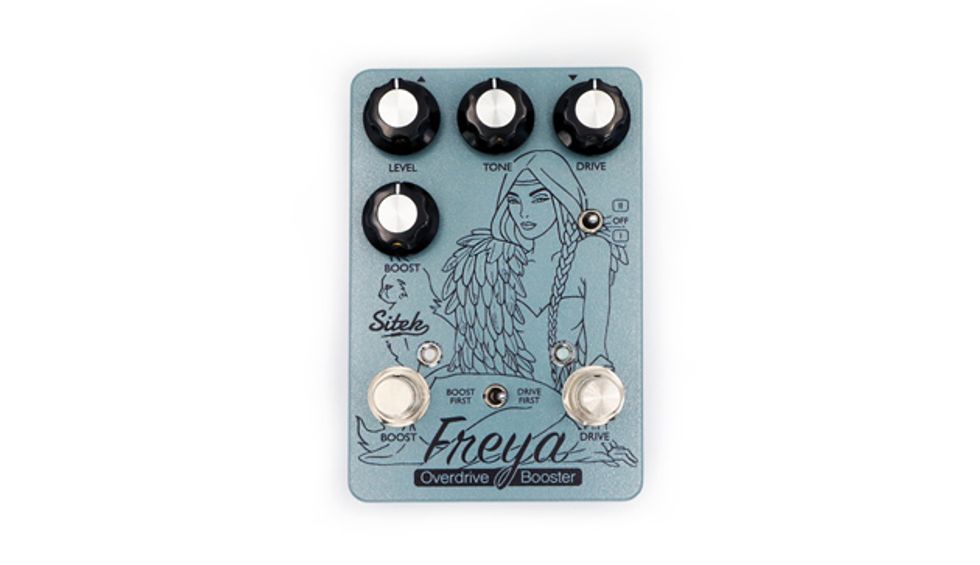
Sitek Guitar Electronics Introduces the Freya Overdrive/Booster - Premier Guitar


Gdynia, Poland (August 3, 2020) -- Sitek Guitar Electronics has just released their first dual pedal - designed in collaboration with Joss Allen, a YouTube guitarist known for his heavy-metal magic. The Freya is designed around Joss’s amazing style and technique. This versatile dual pedal is a combo of a low to mid-gain overdrive and a transparent high headroom booster.

Freya’s overdrive section was designed to provide a focused mid-push with three distinctive clipping voices, a vast amount of headroom with great clarity of bottom and top-end of the signal. It’s smooth on the clean channel and tightening things up on the dirty channel. Users may choose between 3 clipping options from smooth, bluesy breakup, open and focused boost to push the front-end of a dirty channel and mid-rich lead tone. The pedal also includes a full range, transparent booster section providing up to 12dB of clean boost. Both sections can operate independently and their order is easily switchable for even more tonal options.

Features:

  • 5 simple controls: Level, Tone, Drive, Boost and a 3-way clipping switch
  • Switchable order of Boost and Overdrive
  • High quaity DeMont Smooth-Click Footswitches
  • Powdercoated enclosure to withstand tough stage conditions
  • Reverse polarity protection
  • True Bypass
  •  
  • Power supply 9V DC or 9V battery
  • Top-mounted jacks
  • Compact footprint

Freya Overdrive/Booster is available to purchase on Reverb.com or directly from the Sitek Guitar Electronics website and carries a price of $240.

For more information:
Sitek Guitar Electronics

The Link Lonk


August 04, 2020 at 04:28AM
https://ift.tt/31hKdCi

Sitek Guitar Electronics Introduces the Freya Overdrive/Booster - Premier Guitar

https://ift.tt/2DVP6sH

Rocket Lab pinpoints cause of last month's booster failure - New Atlas


Space startup Rocket Lab experienced a notable hiccup in early July, when one of its Electron boosters was lost on its way to orbit, along with the seven satellites onboard. The company now claims to have pinpointed the source of the problem, and has gained regulatory approval to return to the launchpad later this month.

Following a series of early mishaps, it has been relatively smooth sailing for Rocket Lab since first reaching orbit in January of 2018. It has gone on to deliver satellites to orbit for NASA, DARPA and the US Air Force, and even started to explore methods of recycling its rockets after launch .

So when the Electron booster failed several minutes into the second-stage burn during last month’s “Pics Or It Didn’t Happen” mission, it marked a significant setback for the relatively young company. A joint investigation into the cause of the failure carried out with the Federal Aviation Administration (FAA) has, however, quickly zeroed in on the issue, which caused the engine to perform a safe shutdown and bring the mission to an end.

This controlled shutdown actually enabled Rocket Lab to continue collecting telemetry from the vehicle, with the investigation team since reviewing more than 25,000 channels of data. This revealed a “single anomalous electrical connection” as the issue, which remained secure throughout pre-flight testing but became “intermittently secure” during flight.

As a result of this, the electrical component endured additional heating and thermal expansion, liquefying some of the surrounding components and causing the electrical system to disconnect. Rocket Lab CEO Peter Beck says this wasn’t an issue the team had observed before in any of its 12 Electron launches.

“The issue occurred under incredibly specific and unique circumstances, causing the connection to fail in a way that we wouldn’t detect with standard testing,” says Beck. “Our team has now reliably replicated the issue in test and identified that it can be mitigated through additional testing and procedures.”

Rocket Lab says that corrective measures are now underway and the FAA has given it the all-clear to get back to business. It has scheduled a launch for later this month from its complex on New Zealand’s Māhia Peninsula, with further details on the customer and launch window to be revealed in the coming days.

“It’s a testament to Electron’s track record of reliability that the FAA has approved us for return to flight already,” says Beck. “Electron was the 4th most frequently launched rocket in the world last year and prior to the anomaly we had deployed 53 customer payloads to orbit without fail. Returning to the pad with an even more reliable vehicle for our mission partners is our top priority.”

Source: Rocket Lab

The Link Lonk


August 03, 2020 at 12:45PM
https://ift.tt/31gAlbW

Rocket Lab pinpoints cause of last month's booster failure - New Atlas

https://ift.tt/2DVP6sH

Sunday, August 2, 2020

Savvy mum put kid’s booster seat in dishwasher to clean it – and it’s come out perfect - The Sun


FEEDING time always ends up looking like a disaster zone when you have little ones, with food covering surfaces you didn't even know existed.

So when it comes to booster seats, high chairs and, well, anything else belonging to your kids, finding a fuss-free way to get them clean is paramount.

These seat can get seriously dirty after a feed

3

These seat can get seriously dirty after a feedCredit: Facebook/Mums Who Clean

This is where a dishwasher comes in handy as one mum revealed she used hers to get her kids' plastic booster seat spotless.

While it's normally reserved for dishes, cutlery, pots and pans, it's worked wonders on the little ones seat as well, as it's completely spotless and not damaged at all.

The best part is that it fits perfectly in the bottom rack so you can just pop it straight in when it needs a clean.

Branding it a 'game changer', the mum shared her new found hack online with members of the Mums Who Clean Facebook group.

But they fit perfectly inside a dishwasher for a super quick and easy clean

3

But they fit perfectly inside a dishwasher for a super quick and easy cleanCredit: Facebook/Mums Who Clean

She wrote: "Game changer.Why didn’t I think to do this when my kids were little- booster seat came out squeaky clean in the dishwasher

And others agreed with so many raving about the simple idea claiming they wish they'd thought of it sooner.

"Wondering why I haven’t thought of this yet lol," one person wrote.

And another echoed: "Why haven’t I thought of this I hate trying to clean mine."

Other mums were thankful for the idea

3

Other mums were thankful for the ideaCredit: Facebook/Mums Who Clean

While a third added: "Wow, never would have thought."

Some revealed they use their bath and even a presser washer to clean high chairs, booster seats and other grotty bits, while others say they too use the dishwasher for EVERYTHING.

"When my twins where little this was a life saver," one mum said.

And another agreed: "I've been doing that with mine too. Should've mentioned it. How good is it!

Meanwhile a third shared: "Also good for bringing hats up brand new."

Meanwhile a mum shares ‘saviour’ ice lolly hack – and all you need is a Pringles lid.

And a mum claims 99p hairspray is the secret to banishing head lice calling her technique ‘life-changing’.

Plus mum-of-22 Sue Radford spends hundreds at Primark as she unloads bags of clothes for her whole brood after a mega shop.

Woman shares tips for getting rid of lunchbox stains in under a minute on TikTok
The Link Lonk


August 03, 2020 at 05:01AM
https://ift.tt/39W9Ooj

Savvy mum put kid’s booster seat in dishwasher to clean it – and it’s come out perfect - The Sun

https://ift.tt/2DVP6sH

Featured Post

Booster may be needed for J&J shot as Delta variant spreads; some experts already taking them - ABC27

Coronavirus by: Reuters , via Nexstar Media Wire Posted: Jun 29, 2021 / 02:02 PM EDT / Updated: Jun 29, 2021 / 02:02 PM EDT THORN...

Popular Posts