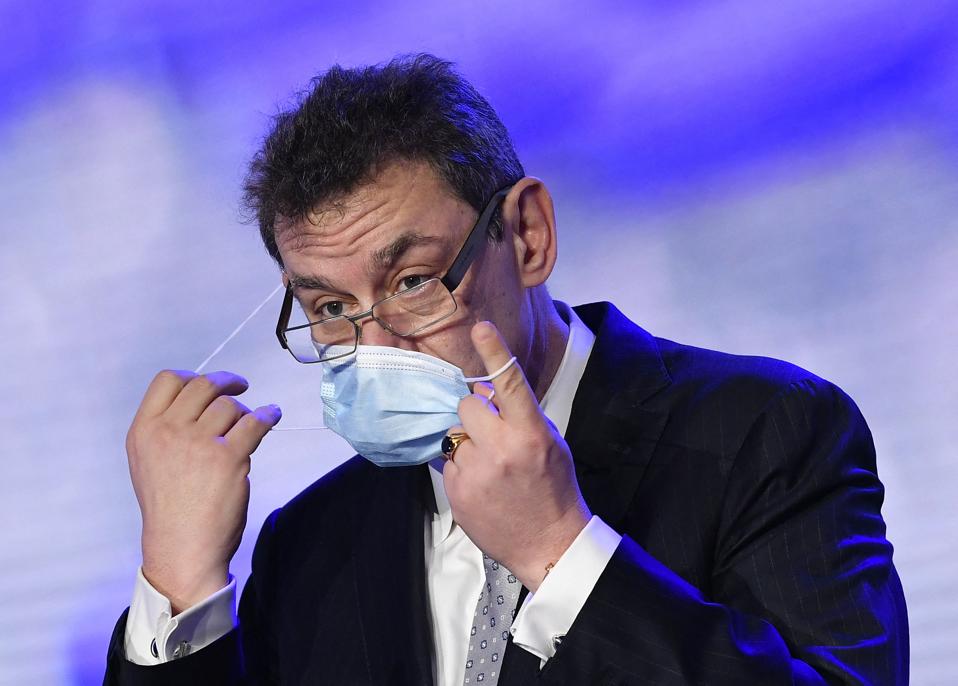
Pfizer CEO Albert Bourla addresses a press conference with European Commission President Ursula von ... [+]der Leyen, on April 23, 2021. In a statement, von der Leyen referenced ongoing negotiations with Pfizer/BioNTech on a contract to deliver 1.8 billion doses of vaccine for the years 2021 to 2023. (Photo by JOHN THYS / POOL / AFP) (Photo by JOHN THYS/POOL/AFP via Getty Images)
POOL/AFP via Getty Images
Market moves indicate Covid-19 vaccine boosters will likely be a reality soon. Among many recent market developments, the E.U. is negotiating a contract with Pfizer/BioNTech to deliver 1.8 billion doses for the years 2021 to 2023. The U.K. has secured an additional 60 million doses of the Pfizer/BioNTech Covid-19 vaccine. And, Israel purchased 9 million more Pfizer/BioNTech vaccines to ensure capacity for boosters through 2022.
The other manufacturer of mRNA Covid-19 vaccines, Moderna, has committed itself to producing three billion doses annually.
Perhaps most telling that the world intends to booster up is a recently published IQVIA report which states that worldwide $157 billion will be spent on Covid-19 vaccines through 2025.
In a statement last month, Pfizer CEO Albert Bourla asserted boosters will be very likely 6 to 12 months following the initial two-dose regimen. Echoing Bourla’s comments, BioNTech co-founder and CMO Dr. Ozlem Tureci said an additional shot of the two-dose vaccine will be needed as immunity wanes over time. Tureci played a key role in developing the mRNA vaccine.
So far, both mRNA-based vaccines have reported remarkable efficacy at the 6-month mark, at more than 90%, with even greater protection against severe illness and death.
Beyond 6 months, however, the durability of immunity remains unclear. Furthermore, manufacturers must determine whether additional doses will be needed to combat certain new variants of concern, including the P.1 and B.1.617 variants that have wreaked havoc in Brazil and India, respectively.
Pfizer and BioNTech are investigating the efficacy of a third dose administered 6 to 12 months after the first two-dose regimen. Moderna is conducting a similar trial. The firms are also conducting trials to test vaccine efficacy against several of the variants of concern.
MORE FOR YOU
There may be a conflict of interest when the CEO of a company that manufactures boosters declares we need boosters. Nonetheless, cynicism aside, what we can safely assume, based in part on a large-scale Danish study of reinfections, is that following infection immunity diminishes over time. According to the study, the vast majority of people who recover from Covid-19 remain protected from the virus for at least six months. But the risk of reinfection appears to be higher among people over the age of 65. Prior infection with the coronavirus reduced the chances of a second bout by only about half in those older than 65.
What the Danish study did not investigate is whether the immunity conferred by way of vaccines is stronger than natural immunity. That would appear to be the case in clinical studies, at least for the mRNA vaccines which have more than 90% efficacy 6 months after a completed regimen. The findings showed only a small decrease in efficacy and a slight antibody decline.
Perhaps it’s no surprise then that at the time that Pfizer CEO Bourla said people will likely need a Covid-19 vaccine booster, and annual vaccinations akin to influenza shots are probable going forward, some public health and infectious disease experts expressed skepticism.
Dr. Paul Offit, a vaccine expert at Children's Hospital of Philadelphia, said that there isn’t sufficient data yet to make that judgment call. Similarly, Dr. Monica Gandhi, epidemiologist and public health expert, suggested boosters may not be necessary. After all, the clinical studies haven’t shown an appreciable decrease in antibodies at 6 months.
Nevertheless, for real-world evidence that goes beyond a half year we still need to wait and see. The vaccine rollout began roughly five months ago. And so, the 6-month mark is fast approaching. Dr. Fauci, Director of the U.S. National Institute of Allergy and Infectious Diseases and the chief medical advisor to the President, is on record as saying that it should be known for sure by this autumn whether booster Covid-19 vaccines will be necessary and what timetable to expect.
Of course, there’s also the question of whether the necessity of boosters will depend on the vaccine type given to an individual. It may be that vaccines with potent immunity like the mRNA agents will require less frequent boosters than others. But it’s not been ascertained at this point.
Further, variants of concern remain a wildcard in Covid-19 transmission. It may be that how soon people ought to be re-vaccinated depends on how the novel coronavirus evolves in terms of its ability to elude current vaccines. The ongoing extraordinarily high numbers of daily cases and the fact that large swaths of the globe are unvaccinated are sure to spawn new variants, one or more of which could evade vaccines.
Boosters are a rather safe bet at this point, as market moves indicate. What’s less of a sure thing is how effective our current set of vaccines will be against certain variants of concern.
While the Biden administration has been racing to maximize the number of Americans vaccinated against COVID-19, government researchers have also been working on what form the next generation of vaccines will take.
They may be combined with the seasonal flu vaccine, or could come in the form of pills or patches instead of shots. Scientists also envision vaccines that might shield against viruses beyond SARS-CoV-2 (the virus that causes COVID-19) that could avert future pandemics.
And they're evaluating whether those who are fully vaccinated might need booster shots later this year. Additional shots could be virtually identical to the first doses, given as a safeguard against the possibility of waning immunity or tweaked to defend against mutant strains that are raising concerns.
Here's what we know about the next-generation landscape of coronavirus vaccines:
Booster shots
The three major vaccine manufacturers with shots authorized in the U.S., Pfizer, Moderna, and Johnson & Johnson, have plans for — or are already testing — an additional shot. The booster shots are expected to be very similar to current vaccines but could come in a smaller dose.
"With many vaccines, we understand that at a certain point in time we need to boost, whether that's 9 months, 12 months. And we are preparing for that," Dr. David Kessler, chief science officer for the administration's COVID-19 response, told lawmakers last month.
Boosters might also be blended with the annual seasonal flu shot. Moderna said it's planning early trials of these kinds of combined shots this year. Other combinations of vaccines are already frequently used to immunize younger children against multiple diseases in a single doctor's visit.
However, administration officials say no decision has yet been reached on how booster shots would be used — or whether they would even be needed.
What about variants?
While booster shots renew the body's immunity to the virus by mimicking parts of the original strain first identified in China, vaccine makers are also trying to tweak their doses to address newer variants of SARS-CoV-2, some of which are spreading more quickly and may cause more severe illness.
This isn't unusual; seasonal flu vaccines are regularly changed to address mutations spotted in the virus around the world.
Dr. John Mascola, head of the Vaccine Research Center at the National Institute of Allergy and Infectious Diseases, says understanding SARS-CoV-2's mutations is "a major focus" for federal scientists.
The NIH has devoted funding and researchers from across its campus to answering key questions about variations in the virus. Some scientists are focused on testing the impact mutations could have on vaccine efficacy. Others are working to better understand and map its "epitopes," spots where antibodies can target SARS-CoV-2's signature spike protein.
"That's sort of a basic scientific body of knowledge that, in the long run, can guide antibody therapies but also guide vaccine design. Basically saying, 'Can I understand how the virus is going to escape and can I account for that,'" Mascola explained.
Moderna and Pfizer are both pursuing possible versions of their doses adjusted for the B.1.351 variant first spotted in South Africa, though research so far suggests their current vaccines may remain mostly effective against the mutant. The AstraZeneca-Oxford vaccine, which isn't authorized for use in the U.S., has been found to provide only "minimal" protection against the South African variant.
"The reason they are choosing that strain is it's one of the ones we know about now, with the variants of concern that are out there, that's the most antigenically different," said Mascola.
Mascola also raised the possibility that developing a booster with the South Africa variant could provide more protection.
"For example, if we boost with the B.1.351 strain and we see that the serum antibodies are broader, not only do they neutralize the original strain but also B.1.351 and other variants, then that may be a preferred approach," added Mascola.
Skipping the needle
There's also a substantial effort underway to come up with vaccines that don't rely on needles and syringes to be administered, after record demand strained the complex global supply chain amid the pandemic. Some projects could make it easier to store and transport the vaccine, without the expensive freezers and dry ice currently required for the Moderna and Pfizer vaccines.
For example, future doses could be inhaled through the nose instead of shot into arms. The NIH recently touted promising results from a single-dose intranasal vaccine tested on monkeys, similar to AstraZeneca's.
The Biomedical Advanced Research and Development Authority (BARDA) last year also announced millions of dollars in contracts to develop a handful of other alternatives delivered by wearable patches or pills, deploying the agency's experts to shepherd developers through early trials and regulatory approvals.
Vaxess Technologies claims its self-applied patch is shelf stable and painless, delivering its vaccine through microscopic "projections" that dissolve into the skin.
"We're working with the companies, with the different technologies, to potentially partner them with the six vaccine candidates that are currently being supported by the U.S. government," said BARDA Director Gary Disbrow.
BARDA hopes the firms can show in smaller trials that they trigger the same kind of immune response as the currently authorized vaccine doses, which could speed their availability to the general public.
"The technologies have been shown for other viral pathogens, but we are trying to support them for the clinical trials. And again, the timing is really dependent upon whether we can identify those correlates for protection," added Disbrow.
A "pan-coronavirus" vaccine
Scientists at the Walter Reed Army Institute of Research recently announced early trials of a vaccine relying on a "spike ferritin nanoparticle" that has shown some promising results against variants of SARS-CoV-2 as well as the earlier, related virus known as SARS-CoV-1.
"Over the last four years, we've been working on trying to move away from one virus, one vaccine. And try to really have vaccines for the future," says M. Gordon Joyce, a top scientist at WRAIR's emerging infectious diseases branch.
Unlike the other currently authorized vaccines, WRAIR's experimental doses are designed to deliver engineered triplets of the spike proteins they hope will train immune systems to produce a greater quantity and diversity of antibodies. Similar to other classic "protein vaccines," developers say these doses could prove to be sturdier than vaccines that require carefully controlled climates to keep stable.
The researchers say they are in talks with commercial partners for possible next steps for their shots. The current batch of doses being tested could be developed into a "variant-proof" vaccine, booster shots, or serve just as a "proof of principle" for future vaccines aimed at broader groups of coronaviruses.
"We didn't think that we would already be here with a pan-SARS-like virus vaccine, but it appears we may be there," says Kayvon Modjarrad, director of WRAIR's emerging infectious diseases branch.
The mass production of the COVID-19 vaccines has been nothing short of a feat of medical science, and the rollout across many countries has been incredible. But there is a fly in the ointment – two, to be precise: How long does the protection provided by a vaccine last? And, will the vaccines be effective against emerging variants?
The tragic situation unfolding in India is a case in point when it comes to fighting new variants of the coronavirus. India has a population of 1.4 billion and had an excellent start to its vaccination programme. It is also home to one of the biggest manufacturers of vaccines in the world: the Serum Institute of India (SII), which was making and exporting millions of vaccines to other countries as cases were coming down in India.
But due to recent public gatherings, and the early easing of lockdown measures, India has found itself at the epicentre of the pandemic, setting global records for daily cases and deaths. The world has watched in horror as scenes of people struggling to breathe outside hospitals have streamed across news networks.
The SII and the Indian government have now reduced the volume of vaccine being exported from India, but this has come too late as they are also struggling to obtain the raw materials needed for vaccine manufacture from the United States, which is focused on getting its own population vaccinated.
This highlights the problem of Western countries prioritising their own vaccinations while other countries miss out. It also shines a light on holes in the World Health Organization’s plans to get vaccines to poorer countries through its COVAX scheme. As the pandemic unfolds, it is becoming clearer that there are likely to be huge outbreaks in some countries, and a global firefighting approach will most likely be needed. India is one of the world’s fastest growing economies, but the pandemic has brought it to its knees, forced to ask for foreign aid.
The longer the virus is able to run riot in India, the more people it will infect and the more likely it is that further mutations will emerge.
Scientists believe the latest Indian “double mutant” variant exhibit traits that could make it more infectious and less susceptible to vaccine-induced immunity, and we may well see the virus mutate further and in a direction that will make the current batch of vaccines even less effective.
As new variants emerge, therefore, we are likely to need booster shots to maintain our levels of protection or to fight new variants.
How long does protection from a COVID vaccine last?
Another issue is that we do not know for sure how long protection lasts after having a COVID-19 vaccine. Most experts agree that protection is likely to last at least six months but only time will tell and further research is needed.
According to a study of 927 people, conducted by Pfizer and published on April 1, 2021, the vaccine offered 91.3 percent protection against COVID-19, measured from seven days through to six months after the second dose.
The company is also conducting a study into the effectiveness of a third dose of the vaccine – essentially a booster, given six to 12 months after the second dose. The study is part of Pfizer’s clinical development strategy to determine the effectiveness of a third dose of the same vaccine against evolving variants.
A study looking at the length of time the Moderna vaccine gives protection also showed those people who were given two doses of the vaccine had good antibody levels at six months after the second dose.
There is less data available for the Oxford-AstraZeneca vaccine. However, when looking at the effectiveness of the vaccine after giving the two doses at different intervals, studies have shown that the vaccine efficacy reached 82.4 percent after a second dose for those who had a dosing interval of 12 weeks or more, meaning if the two doses are given at least three months apart they offer more than 82 percent protection. It is therefore reasonable to think the protection will last at least a further three months after the second dose, although more data is needed.
It is entirely possible that vaccine-induced protection will last longer than the six months being proposed by these findings, but many experts believe that the antibodies created by vaccines will wane over time and booster shots will be required.
How will boosters work?
Booster shots work like a wake-up call for your immune system. Vaccines stimulate the body to create antibodies that are capable of recognising the coronavirus and, should you encounter it, killing it and any cells that have been infected by it, usually before you develop any symptoms.
Once this is complete, memory T and B immune cells patrol the body in case another encounter occurs. Over time, the numbers of these memory cells start to dwindle and the immune system may “forget” how to recognise the pathogen or germ causing the illness effectively in the future.
Booster shots serve to “remind” the immune system how to recognise the specific pathogen causing the disease. It means your body is more likely to respond quickly and more effectively after a booster shot.
According to Albert Bourla, the chief executive at Pfizer, the answer to whether we will need booster shots is “yes”. Speaking with American healthcare company CVS Health on April 16, Bourla said: “There will be likely a need for a third dose somewhere between six and 12 months [following the first two doses] and then from there, there will be an annual revaccination.”
Nadhim Zahawi, the UK’s vaccine minister, has said people who are clinically extremely vulnerable could begin to receive booster shots against new coronavirus variants as early as September. And David Kessler, chief science officer to the White House coronavirus task force, spoke to a congressional committee in the US about the need for booster shots, saying: “We understand that at a certain point in time we need to boost, whether that’s nine months, 12 months, and we are preparing for that coming.”
Booster shots are not a new phenomenon; we use them for other vaccines. We give booster shots of the measles, mumps, rubella (MMR) vaccine to children to ensure longer lasting and effective immunity and we give annual flu vaccines to clinically vulnerable people to protect against new strains of the flu virus.
Can boosters protect us from new variants?
New variants of the coronavirus are emerging all over the world. Only a handful are “variants of concern” – those that may harbour mutations enabling them to evade our immune responses triggered by vaccines. Booster shots may also serve as a way to stimulate the body to recognise new variants of the coronavirus as well.
Variants of concern include the South African, Brazil and Indian variants which have emerged in recent months (the vaccines appear to be effective against the UK variant). These variants include mutations of the spike protein (the part of the virus that binds to human cells) which might make them harder to recognise by immune cells generated by vaccines.
If these variants become dominant variants or more widespread then booster shots which can protect us against them are likely to be needed. If vaccines do need to be tweaked to be more effective against new variants, manufacturers have said that these will be easy to do and can be done in less than three months.
As time goes on, it is looking more and more likely that booster shots against COVID-19 are going to be needed. Many people argue that there is going to be a never-ending cycle of vaccines and boosters, but we already tolerate this with flu each year and we should start to look at vaccines against the coronavirus as no different to that.
[Illustration by Jawahir Al-Naimi/Al Jazeera]
Progress report: A possible vaccine for malaria
Another serious disease that kills some 400,000 people every year is malaria. But, at last, there may be a solution in sight. On April 23, researchers from the University of Oxford and its partners announced some promising results from tests of its vaccine which they claim is 77 percent effective in preventing malaria – higher than the World Health Organization (WHO) target efficacy of 75 percent.
Malaria is a deadly disease. The majority of deaths from malaria each year occur in Africa and children are worst affected. Malaria is caused by a family of parasites called plasmodium. These parasites are transmitted to humans by female mosquitoes (the males do not tend to feed on blood).
Female mosquitoes bite humans to feed on blood and, in doing so, transmit the parasite to them. By far the most common type of malaria parasite is called plasmodium falciparum which accounts for more than 99 percent of cases in Africa.
The symptoms of malaria include fever, headache, chills, anaemia and respiratory distress. Untreated, the parasites can destroy human red blood cells, cause organs to fail and eventually lead to death. Despite measures such as mosquito nets, insecticides and antimalarial drugs being available, many poorer regions continue to have high mortality rates from malaria, especially among children.
After the first exposure to malaria, some level of immunity is acquired so when an individual is infected again they have fewer symptoms. However, this immunity requires regular exposure to malaria through bites so if a person leaves an area where the disease is endemic and then returns again, their immune system may have “forgotten” how to fight malaria and they can get severe symptoms again.
Many pharmaceutical companies have attempted to come up with a malaria vaccine in the past but have fallen short of the 75 percent efficacy rate recommended by the WHO, which is why this latest news is a reason to celebrate.
The researchers have published their phase 2b clinical trials in The Lancet. The study examined 450 children aged between five months and 17 months across 24 villages in the Nanoro region of Burkina Faso in West Africa. The children were randomly split into three groups: the first group was given the new malaria vaccine – known as R21/Matrix-M – at a high dose; the second group received the same malaria vaccine but at a lower dose; and the final group received a “control” rabies vaccine.
Doses were administered from early May 2019 to early August 2019, largely prior to the peak malaria season in the region. The researchers have now reported a vaccine efficacy of 77 percent in the higher-dose group and 71 percent in the lower dose group. Importantly, no serious side effects from the vaccine were found during the trial.
The study will now move to the all-important phase 3 part of the trial, for which 4,800 children, aged five months to 36 months, across four African countries, will be recruited. If this study shows the same levels of efficacy and safety as the phase 2b trials, but on a larger scale, then the hope is that we will have an effective malaria vaccine we can use to protect at-risk populations and hundreds of thousands of lives will be saved. The team has partnered with the Serum Institute of India to manufacture at least 200 million doses annually in the coming years, should the phase 3 trials go well – there is no indication as yet when this might start.
Gareth Jenkins, of Malaria No More UK, said in response to the vaccine news: “A world without malaria is a world safer both for the children who would otherwise be killed by this disease, and for us here at home. Countries freed from the malaria burden will be much better equipped to fight off new disease threats when they inevitably emerge in the future.”
In the Doctor’s Surgery: Supporting families through a funeral during the pandemic
When my father passed away more than 10 years ago, it was an incredibly difficult time for the whole family. Community support is central to South Asian culture, both in times of celebration and, more importantly, in times of grief. Within an hour of his death, news of my father’s passing had spread among my parents’ friends and people came to our home to show their support.
My mum depended on these people; they would turn up with dishes filled with food so we did not have to cook, they would make endless cups of tea for the mourners who visited, they would clean up after guests left so we were not left with that job and they would sit and recite verses from the Quran which offered my mum some comfort. For me, it meant I could get on with the practical job of arranging the funeral, knowing my mum was being looked after by the community.
This past year has seen our community and others like it robbed of these small but important gestures. COVID has put an end to large gatherings in many countries and numbers at funerals have been severely restricted. This was never more apparent than at the recent royal funeral in the UK when the queen was seen sitting alone during the service for her late husband, Prince Phillip.
As a family doctor, I speak to people who have lost loved ones more often than I would like. The pandemic has meant I do this even more frequently than ever before, offering my support and advice when needed but more often just listening to how they are feeling.
Although my patients fully understand the need for restrictions in order to curb the spread of the virus, they often tell me how this has adversely affected their period of grieving. One man told me: “We believe the more people who turn up at your funeral and pray for you, the more blessings you have when you arrive at the gates of heaven. My mother only had 30 people at her funeral and none of them was able to come back to our home afterwards. It was heartbreaking.”
I tried to reassure him that although people could not visit, they could quietly pray for her in their own homes if that was what the family wanted.
More recently, a husband who was distraught after losing his wife to COVID said to me: “Her parents [who lived in Pakistan] cannot even attend her funeral. Imagine what that must feel like to them.”
People expect doctors to have an answer to every situation but I did not have an answer to that.
Losing a loved one is hard enough when we were not living through a pandemic, but almost every culture across the world relies on communities, friends and families to come together in times of grief to share the burden and to help ease the pain. I worry that, for my patients, this lack of physical human support will only serve to prolong their grief and will have an untold negative effect on their mental health.
[Illustration by Jawahir Al-Naimi/Al Jazeera]
And now some good news: Could a COVID-19 pill be available soon?
The UK government has announced that an Antivirals Taskforce is to be set up for the trial of medication that could be used to treat COVID-19 at home for those not sick enough to need hospitalisation.
The hope is that this anti-viral treatment could shorten the illness and reduce the risk of spreading the illness to others. The drugs may also be given to close contacts of someone who has tested positive to help contain an outbreak.
One drug being touted as a contender is the Pfizer-produced PF-07321332, a drug that has shown to reduce viral replication in laboratory studies. Another drug being studied is the anti-viral medication, molnupiravir, which was originally developed to treat SARS and MERS. So far, this medication has been shown to be effective in reducing viral replication in animal tests and is currently being tested in humans.
So far, we have had limited success with antiviral medication, but this may change as further research is carried out. If successful, the medication could be used worldwide to manage patient care at home and reduce deaths. It may be particularly useful for people who are unable to have the COVID vaccines due to medical reasons.
Reader’s question: I have had my first dose of the AstraZeneca vaccine, but I am now worried about blood clots. Can I request an alternative vaccine for my second dose?
While studies are continuing as to whether mixing doses of vaccines will offer better or worse protection, there are no results as of yet, meaning we would not currently advocate mixing doses of different vaccines. Most health authorities agree that the benefits of having the AstraZeneca vaccine outweigh the risks, particularly in those above 30 years of age. The risk of developing blood clots from being infected by COVID itself is significantly higher than the risk associated with the AstraZeneca vaccine.
My advice is to take up the vaccine that is offered to you whatever brand it is – it will offer you protection against serious illness from COVID-19.
MADISON, Wis. — If you got a COVID vaccine, you’ve likely been thinking about how long it will last. Many doctors have said booster shots will probably be necessary, but they’re still trying to figure out when that might be.
“In a normal, non- pandemic situation, we’d probably have those answers before the vaccines were rolled out, but we’re not in that situation and we needed to get people vaccinated quickly,” said Dr. William Hartman at UW Health.
He said the data doctors do have shows that Pfizer and Moderna’s vaccines are still at least 90% effective six months after being injected.
Sometime after those six months, a person’s immunity to the virus will drop off. It could be a year after their first shot or even three years later, but enough time hasn’t passed for this to be tested.
Johnson & Johnson is a different type of vaccine.
“With these adenovirus vaccines, it’s possible that the efficacy of the vaccine actually increases as time goes on,” said Hartman.
So if you got Johnson & Johnson’s vaccine, your immunity is likely getting better as time goes on. It will be more effective at three months than it was one month after your shot. So a booster might be needed later than it would be for those who got Pfizer or Moderna.
“I do anticipate all these vaccines kind of having different points where they hit that peak, and then you see a drop in the immunity,” said Hartman. “At some point, is it all going to be one vaccine and everyone can be on the same timecard.”
But variants will always threaten to slow the vaccination process down and require booster shots even sooner. While Pfizer and Moderna have proven to be effective against the UK variant, other variants or new variants could be resistant.
“If say the South African variant came in (to Wisconsin) or the California variant came in, we may need to re look at the boosters in terms of do we need to make a booster against that variant,” said Hartman.
It’s also not known yet if you will need to get the same brand of the booster shot that you did of the original vaccine.
COPYRIGHT 2021 BY CHANNEL 3000. ALL RIGHTS RESERVED. THIS MATERIAL MAY NOT BE PUBLISHED, BROADCAST, REWRITTEN OR REDISTRIBUTED.
The UK will roll out a covid-19 booster vaccine at the beginning of autumn in order to protect the most vulnerable ahead of winter, the Department of Health and Social Care (DHSC) has announced.
As part of this, the government’s vaccines taskforce has secured an additional 60m doses of the Pfizer BioNTech vaccine, which will be used alongside the other vaccines already purchased.
Details on how the programme will work have not yet been made public, however the DHSC said the booster dose will be given based on clinical need.
The BMJ revealed in March that a covid-19 booster vaccine would likely be rolled out in the autumn to avoid another winter surge.1
The final policy will be informed by advice from the Joint Committee on Vaccination and Immunisation and the results of clinical trials assessing the impact of mixing approved covid-19 vaccines.
Health secretary Matt Hancock said, “Our vaccination programme is bringing back our freedom, but the biggest risk to that progress is posed by a new variant.
“We’re working on our plans for booster shots, which are the best way to keep us safe and free while we get this disease under control across the whole world. These further 60m doses will be used, alongside others, as part of our booster programme from later this year, so we can protect the progress that we’ve all made.”
Vaccines minister Nadhim Zahawi said, “We are doing everything we can to make sure the most vulnerable are protected from covid-19 now and in the future. In the meantime, we are making great progress with our vaccination rollout and I urge everybody to get their vaccines as soon as they are eligible.”
The UK has secured deals for 517 million doses of eight different covid-19 vaccines or candidate vaccines for a population of 67m people. This includes 100m doses of the Pfizer vaccine, 100m of the Oxford AstraZeneca, 17m of the Moderna, 30m of the Janssen, 60m of the Novavax, 100m of the Valneva candidate, 60m of the GlaxoSmithKline and Sanofi Pasteur candidate, and 50m of the CureVac candidate.
The new deal comes as the World Health Organization criticised the “shocking imbalance in the global distribution of vaccines” and called for distribution to be fairer.
“On average, in high income countries almost one in four people have received a covid-19 vaccine. In low income countries it’s one in more than 500,” WHO director general Tedros Adhanom Ghebreyesus said in a press conference earlier this month.
This article is made freely available for use in accordance with BMJ's website terms and conditions for the duration of the covid-19 pandemic or until otherwise determined by BMJ. You may use, download and print the article for any lawful, non-commercial purpose (including text and data mining) provided that all copyright notices and trade marks are retained.

 [Illustration by Jawahir Al-Naimi/Al Jazeera]
 [Illustration by Jawahir Al-Naimi/Al Jazeera]


